Arctic Grayling are native to our remote Alaska river system and are abundant throughout the river. They are highly nomadic and migrate throughout the river system as conditions change throughout the season.
The Arctic grayling (Thymallus arcticus) is one of Alaska’s most recognizable freshwater fish, admired for its elegant profile and its tall, colorful dorsal fin that resembles a flowing sail. Grayling inhabit cold, clean rivers and lakes throughout Alaska where highly oxygenated water and abundant insect life create ideal habitat. Their diet is dominated by aquatic insects such as mayflies, caddisflies, and stoneflies, along with small crustaceans and fish eggs, which is why they frequently feed near the surface and respond eagerly to dry flies. In spring, shortly after ice break-up, Arctic grayling move into shallow gravel areas of streams to spawn. Females release thousands of eggs that settle among the gravel, and the young fish grow quickly in productive northern waters. Many grayling live well over a decade and return to spawning areas multiple times throughout their lives.
Fishing for Arctic grayling at Wilderness Place Lodge adds a colorful and exciting dimension to the lodge’s diverse Alaska fishing experience. The lodge is located along scenic Lake Creek, a clear, free-flowing river that drains the Alaska Range and supports healthy populations of grayling alongside rainbow trout and Pacific salmon. The creek’s cold water, abundant insect hatches, and extensive gravel bars create excellent grayling habitat, making it common for anglers to encounter these beautiful fish while exploring side channels, small tributaries, and shallow runs throughout the system.
Grayling are known for their aggressive strikes and willingness to rise to dry flies, which makes them especially fun for both beginner and experienced anglers. At Wilderness Place Lodge, guests often catch grayling while fly fishing with small attractor patterns, drifting nymphs through gentle runs, or casting light spinning tackle along gravel banks and riffles. Their acrobatic fights and vibrant colors make every catch memorable, and they are a favorite species among guests looking to experience the variety of wild fish that inhabit Alaska’s remote rivers. Combined with the lodge’s guided fishing program and spectacular wilderness setting, Arctic grayling provide a unique and rewarding part of the fishing adventure at Wilderness Place Lodge.
At Wilderness Place Lodge, we spin fish for grayling primarily using small, lightweight spinners such as Mepps Aglia, Blue Fox Vibrax and Panther Martin. Bucktail-type spinners are favored as grayling avidly feed on small minnows and insects as their primary diet. We also have much success fishing a nymph fly dropper on a 4 foot leader under a strike indicator much like we do with fly rods. Our 6 – 6/12 foot ultra-light rods and complimentary reels are ideal set-ups.
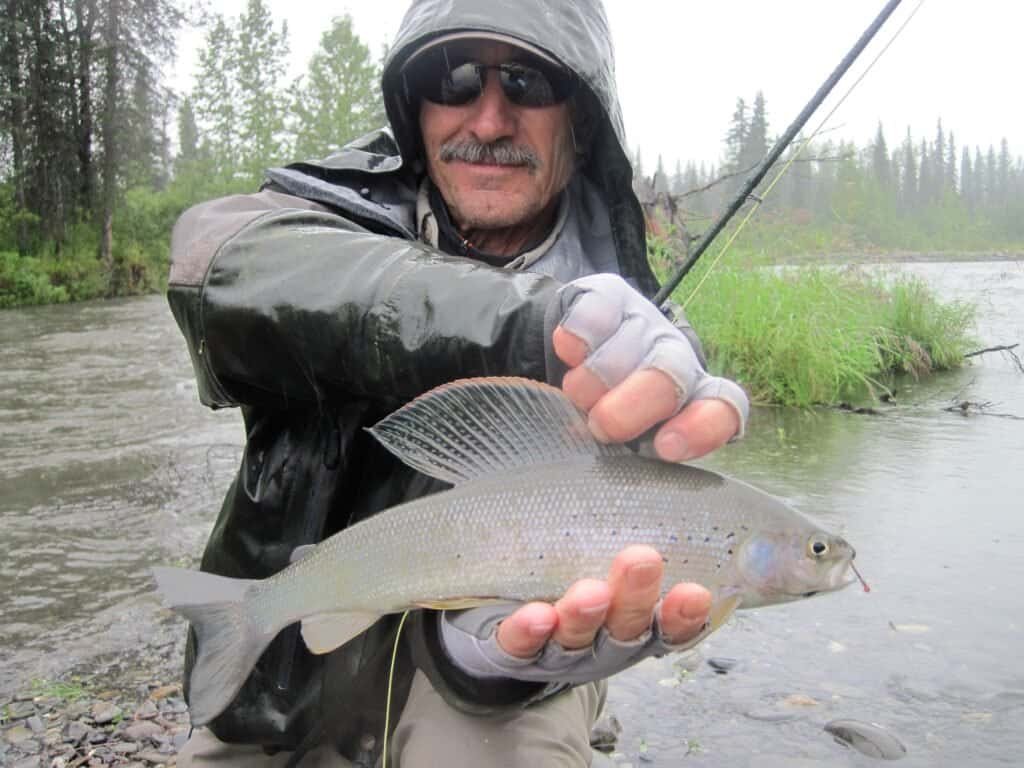
The fun in fly fishing arctic grayling is their receptivity to taking flies on top-water. Dry fly fishing, particularly on float trips and early and late summer at the lodge can be very good and occasionally we catch some very good size fish. Alternatively, grayling eagerly strike a variety of nymphs, small minnow imitations and egg patterns. 5-6 weight rod & reel combinations are a great choice with floating fly lines and 6 pound tapered leader.
Dry flies such as the Elk Hair Caddis are preferred and a variety of nymphs, egg patterns and small streamers are effective as well. Streamers are probably the most effective in higher water conditions such as spring time where surface fishing becomes a bit difficult to target fish. Streamers are also effective during spring through mid-June a large amount of salmon smolt migrating downstream provide the main source of forage. Occasionally, grayling will take small mice from the surface, so a fly such as a stimulator pattern is a great choice.